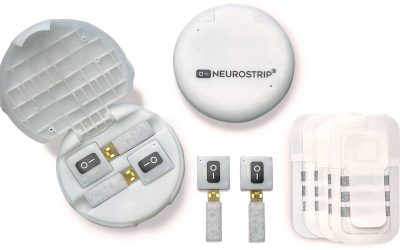
Tired of traditional switching techniques? Look no further! Check out the NeuroNode, a wireless EMG sensor that makes switching faster with less effort.
When utilizing a traditional switching technique, whether that be a push button, proximity switch, or other means of activation, it is reliant on the user to initiate the same movement repeatedly to activate a switch. This can become exhausting for the user and conflict with other daily activities.
Unlike traditional switching techniques, the NeuroNode offers a number of algorithms and techniques that allow it to differentiate intentional from unintentional switch activations for use with AAC devices and apps. At Control Bionics, we have developed an article that introduces Dynamic Scaling and Long Press switching as methods to improve the user’s selection and activation ability for speech generation and computer control.

DIFFERENTIATION
In addition to the Signal On line, the NeuroNode offers a new method for differentiating activation from rest (and volitional movement from non-volitional) with the introduction of a second switching line. Also known as Signal Off, this setting serves as the level of activity (EMG or Spatial) that must be returned to before the NeuroNode will allow another switch.
With this new addition, the user now has a sophisticated method for disallowing any activations due to fasciculation or high tone that other, less adaptable systems would have counted as switches. Rather than filtering with some like “ignore switch repeats,” make switching faster with a filtering method that matches the switching “signature” of the user.
DYNAMIC SCALING
Make it easier to get consistent activations with less effort with Dynamic Scaling. Unlike traditional switches that have a fixed threshold for Switch/No-Switch, Dynamic Scaling is a modality that works alongside Signal On and Signal Off by constantly adjusting these thresholds based on the user’s performance.
Every user is unique and has their own strengths and abilities. This feature customizes the user’s settings so the NeuroNode will adjust to the user’s resting level over time to maintain the same level of switching effort throughout the entire session, eliminating the need to manually change settings during a session.
LONG PRESS
NeuroNode Long Press can be used for Duration-based Switching, in addition to amplitude-only switching. For some users, it may be easier to concentrate on holding a switch for a duration rather than switching on an amplitude set above the level of noise and involuntary contractions. Users who can hold a contraction, although a weak one, will experience significant advantages from this NeuroNode-only switching technique.