- At night. He still needs help repositioning or grabbing an extra blanket, even in the dark.
- During transfers. You can’t aim a device when you’re flying through the air in a lift!
- In the car. We haven’t tried, but the motion and tight space would make setup difficult.
- In bright light. My PALS wears glasses and reflections interfere with the camera.
- While driving a wheelchair. Unless you use Ability Drive — which doesn’t currently work with iOS — you can’t have your device in front of you.
Backup Communication Methods We Use
When we communicate, we use what I think of as an escalation system: start simple and add tools as needed. For a demonstration, check out the video below.
- Switch-Adapted Call Button. To call for help if I’m not nearby, my PALS bumps a switch adapted call button with his head. I also listen to him with a baby monitor.
- Yes/No questions. This is the quickest low-tech AAC method, but the most limited. My PALS blinks for “yes”. I ask common and urgent questions first: “Bathroom? Itch? A bug on you? Change position?” In the dark, this is our only option.
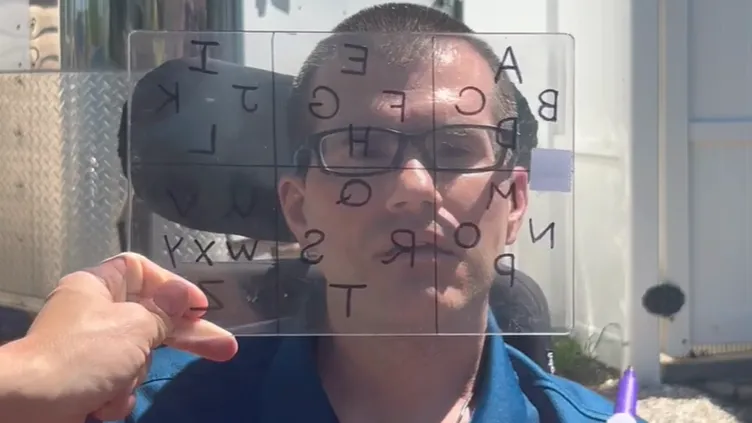
- The grid. I drew a version of this letter board from the ALS association on a piece of clear polycarbonate. I hold it up in front of his eyes, and he can indicate sections of the alphabet. It’s slow, so we use it to spell messages that only take a word or two.
- The laser. I use this backup method a lot. This laser pointer clips on his glasses (there’s a version for a hat) and he points to a communication board on the ceiling. If we are out, we use it with this small board from Bridging Voice.
Complex conversations wait until we’re set up with our eye gaze — and honestly, we were used to that long before ALS. If you’ve ever tried to finish a sentence with toddlers in the room, you already know the drill.
This is the final installment in our current series from guest author, Elizabeth Stricker!
Communicating is tough when your voice doesn’t work. If you have ALS or another condition that affects your voice, an eye gaze device makes a huge difference — but it might not always be available or practical.
When Eye Gaze Isn’t Available
Even the best AAC device isn’t perfect for every situation. Here are times when it just doesn’t work for us, but my PALS still has a thing or two to say:
- At night. He still needs help repositioning or grabbing an extra blanket, even in the dark.
- During transfers. You can’t aim a device when you’re flying through the air in a lift!
- In the car. We haven’t tried, but the motion and tight space would make setup difficult.
- In bright light. My PALS wears glasses and reflections interfere with the camera.
- While driving a wheelchair. Unless you use Ability Drive — which doesn’t currently work with iOS — you can’t have your device in front of you.
Backup Communication Methods We Use
When we communicate, we use what I think of as an escalation system: start simple and add tools as needed. For a demonstration, check out the video below.
- Switch-Adapted Call Button. To call for help if I’m not nearby, my PALS bumps a switch adapted call button with his head. I also listen to him with a baby monitor.
- Yes/No questions. This is the quickest low-tech AAC method, but the most limited. My PALS blinks for “yes”. I ask common and urgent questions first: “Bathroom? Itch? A bug on you? Change position?” In the dark, this is our only option.
- The grid. I drew a version of this letter board from the ALS association on a piece of clear polycarbonate. I hold it up in front of his eyes, and he can indicate sections of the alphabet. It’s slow, so we use it to spell messages that only take a word or two.
- The laser. I use this backup method a lot. This laser pointer clips on his glasses (there’s a version for a hat) and he points to a communication board on the ceiling. If we are out, we use it with this small board from Bridging Voice.
Complex conversations wait until we’re set up with our eye gaze — and honestly, we were used to that long before ALS. If you’ve ever tried to finish a sentence with toddlers in the room, you already know the drill.