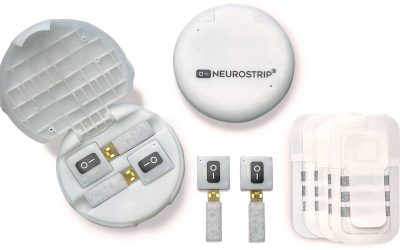
The NeuroNode Trilogy provides three access methods in a single funding accessible solution for degenerative conditions.
MILFORD, OH – Feb.5, 2019 – Control Bionics Launches a new AAC package, the NeuroNode Trilogy, that significantly reduces user fatigue and increases speed for severely disabled people with conditions like ALS/MND, SCI, SMA, and Cerebral Palsy.
Building on their successful NeuroNode EMG Technology, Control Bionics has now combined their latest NeuroNode device, NeuroNode 3.0, with Eye Control and Grid 3 communication software from Smartbox.
Users can now completely eliminate the need for dwell or blink activation while utilizing eye control to access their communication device, a major source of frustration and fatigue with traditional eye control systems. Instead of activating with dwell or blink when using eye-control, users now simply use the NeuroNode 3.0 to select items on the page to generate speech, control their environment, and communicate with the outside world. The result of this combination is significantly reduced fatigue and increased communication output speed.

Rob Wong, CEO of Control Bionics, says, “By combining the new NeuroNode 3.0 technology with eye control and Grid 3, users have the widest possible communication options available in the USA – all in one funding package. All of this combined –priced under $17,000– is going to give potential clients access to a solution never before available. They now have the Power of 3!”
According to Emily Boland, NeuroNode Product Director, “This is a whole new offering to those in need. As a company that strives to be client facing, we feel that we’ve provided a unique solution for those with degenerative conditions. The NeuroNode Trilogy System provides access that changes alongside the client’s needs – with a consistent communication platform. One learning curve, onetime funding application and a solution that lasts a lifetime.”
The NeuroNode is a wireless, wearable AAC device that non-invasively captures the body’s own electrical signals. These signals, generated by minute muscle movements, can be detected even when there is no visible muscle movement, allowing a locked-in user to control a computer with incredible accuracy, and to speak, email, socialize, be entertained, and to control their environment.
While the NeuroNode 3.0 itself provides a powerful alternative access method solution, the new NeuroNode Trilogy System with communication software and eye control has many clinicians heralding it as a game changer for degenerative conditions. The latest NeuroNode 3.0 device is packed with added benefits, including: a smaller, lighter, and more durable design; a 24-hour battery life with hassle-free charging; and a new non-adhesive wearable solution.
NeuroNode Sales Director Meagan Koeneman says, “Having worked for many years selling eye-control units with the market-leading company, I am so pleased to be able to offer clients the NeuroNode Trilogy system as the new standard. It’s so much easier to use and gives clinicians options if and as conditions change for their clients”
The NeuroNode Trilogy was launched at the end of January at the ATIA (Assistive Technology Industry Association) conference in Orlando, Florida. Control Bionics’ funding options are continuously expanding and they’re proud to currently offer funding through Medicare, Medicaid, the Veterans Health Administration, as well as various Education Systems.